
The Indian Stock Market
A Comprehensive Education Guide for Aspiring Investors & Traders.
How the World Earns Money
Selling your Time & Skills for a fixed salary or fee. Safe but limited by your hours.
Creating Systems & Products. Scalable income that doesn't just depend on your time.
Generating Rental Income and capital appreciation through physical property ownership.
Making your Money Work for You by participating in the growth of other businesses.
"If you don't find a way to make money while you sleep, you will work until you die." — Warren Buffett
The Indian Investment Landscape
Typical annual returns (Yield) across different asset classes.
| Investment Type | Expected Returns (p.a.) | Liquidity |
|---|---|---|
| Bank Savings / RD | 3% - 6% | High |
| Fixed Deposits (FD) / Post Office | 6.5% - 7.5% | Moderate |
| PPF / PF / SSY (Sukanya) | 7.1% - 8.2% | Low (Lock-in) |
| NPS / Insurance / Pensions | 9% - 11% | Very Low |
| Mutual Funds (Equity) | 12% - 15% | High |
| Stock Market (Equities) | 12% - 18%+ | Immediate |
*Returns are subject to market risks and historical averages. Past performance does not guarantee future results.
What is the Stock Market?
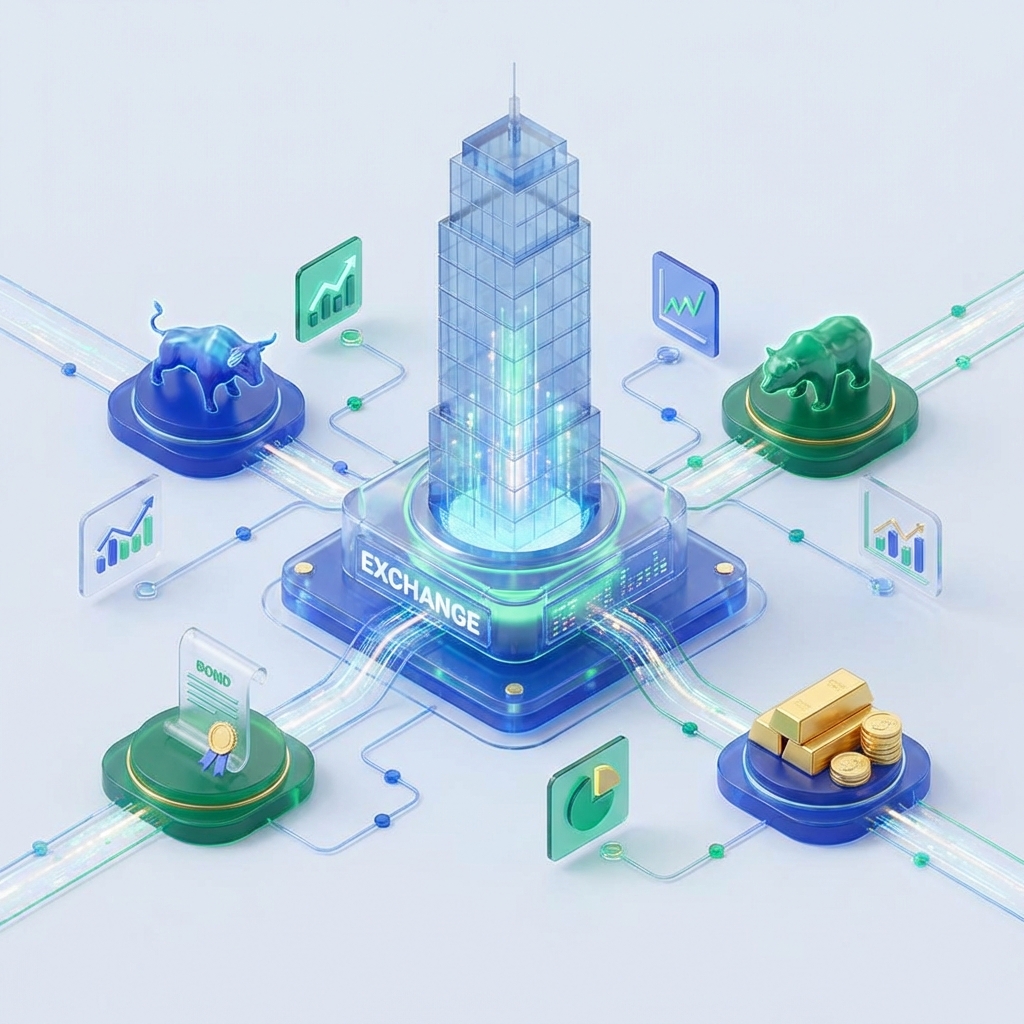
Think of it as a Digital Supermarket where ownership of companies is bought and sold.
- It connects companies needing capital with investors having surplus funds.
- It provides a platform for price discovery and liquidity.
- It is the barometer of the nation's economic health.
Key Entities & Players
Exchanges (NSE/BSE)
The marketplace where the actual trading happens. NSE (National) & BSE (Bombay) are the giants.
SEBI (Regulator)
The watchdog. Their role is to protect investors and ensure the market remains fair and transparent.
Depositories (NSDL/CDSL)
Digital warehouses. They hold your shares in electronic (Demat) form securely.
Brokers
The bridge. They provide the software and platform for you to place orders.
Ways to Build Wealth
Price Appreciation
Buying at ₹100 and selling at ₹150. This is the most common way to earn profit.
Dividends
A share of the company's annual profit distributed directly to your bank account.
Bonus & Splits
Giving additional shares to existing holders or splitting one share into multiple, increasing your quantity.
Types of Financial Instruments
| Instrument | Description | Risk Level |
|---|---|---|
| Equity (Shares) | Partial ownership in a business venture. | High |
| Bonds / Debt | Lending money to Govt/Corporates for interest. | Low to Moderate |
| T-Bills | Short-term debt issued by the Central Govt. | Minimal |
| Mutual Funds | Professionally managed pool of money. | Moderate |
Futures & Options (F&O)
Contracts that derive value from an underlying asset (like a stock or index).
- Futures: Agreement to buy/sell at a set price on a set date.
- Options: Right (but not obligation) to buy/sell.
- Used primarily for Hedging or Speculation.
⚠️ Take Note
F&O involves high leverage and high risk. It requires advanced market knowledge.
Investing vs. Trading
Investing (Long Term)
Holding stocks for years. Focuses on company fundamentals and growth.
Goal: Multibagger Gains
Trading (Short Term)
Buying and selling within days, hours, or minutes (Intraday). Focuses on price action.
Goal: Consistent Cashflow

The Power of Compounding
"Compound interest is the eighth wonder of the world."
Long-term investing acts as a multiplier. Reinvesting your earnings generates its own earnings, snowballing your wealth over decades.
The Trader's Toolbox: Margins
Intraday Profits
Capturing small price movements within the same session. Must close positions before market end.
What is Margin?
The "buying power" given by your broker. It allows you to trade with more money than you actually have.
The Rules
SEBI Peak Margin rules limit how much leverage a broker can give. Safety first!
Trade Life Cycle: Settlement
T Day
Trade Execution
T+1 Day
Settlement Cycle
Credit
Shares/Funds reach your account
India has transitioned to highly efficient T+1 settlement for most stocks.
The Cost of Doing Business
| Charge | Who Takes It? | Description |
|---|---|---|
| Brokerage | Broker | Fee for using the platform/service. |
| STT | Govt of India | Securities Transaction Tax on buy/sell. |
| Exchange Charges | NSE / BSE | Fee for using the exchange infrastructure. |
| GST | Govt | 18% on Brokerage + Exchange charges. |
| Stamp Duty | State Govt | Charge for the legal transfer of assets. |
Understanding Product Types
Choose the right product based on your trading horizon.
CNC (Cash & Carry)
Used for Equity Delivery. You pay the full amount and own the shares. Valid for long-term holding.
NRML (Normal)
Used for F&O Carry Forward. Allows you to hold Futures/Options positions until expiry without full delivery.
MIS (Intraday)
Margin Intraday Square-off. Positions must be closed same day. Offers higher leverage for trading.
Core Order Types
| Order Type | Description | When to Use? |
|---|---|---|
| Market Order | Buy/Sell at the current best available price. | When instant execution is priority. |
| Limit Order | Buy/Sell only at a specific price or better. | When you want to control your entry/exit price. |
| SL-Limit (SL-L) | Trigger price + Limit price. Execution happens at limit. | Safest way to enter breakouts or set exits. |
| SL-Market (SL-M) | Trigger price hits, then becomes a market order. | When you must exit a losing trade at any cost. |
Advanced Trading Tools
🎯 GTT (Good Till Triggered)
Valid for 1 year! Perfect for After Market Hours. Place orders while you sleep; they trigger only when your price hits.
📦 Basket Orders
Execute multiple trades (e.g., Option Spread) in a single click. Essential for professional margin management.
📐 Bracket Orders (BO)
A "3-in-1" order: Entry + Target + Stop Loss. Automates your entire trade lifecycle instantly.
Pro Tip: Use AMO (After Market Orders) between 4:00 PM and 9:00 AM to place trades for the next day's opening.
Start Your Trading Journey
Ready to automate?
Open your AliceBlue account using the link below to get an exclusive discount on your SkandAnalytics subscription fee.
Open AliceBlue Account →After opening, send your Client ID to our support for discount activation.
The Ultimate Battle: ₹10 Lakh Capital
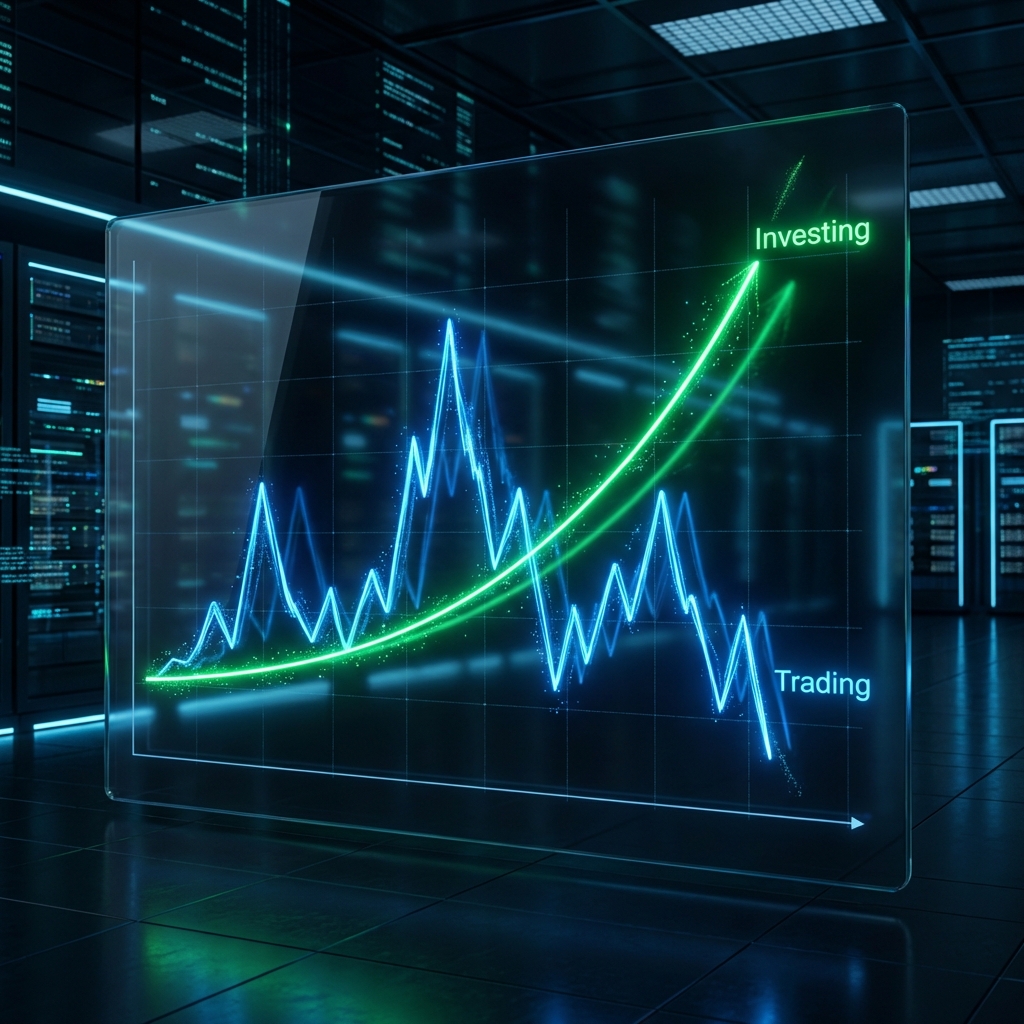
🌳 The Investor (The Wealth Creator)
- Price Action: 18% CAGR (Base Growth)
- Extra Yield: Dividends + Reinvestment
- Quantity Multiplier: Bonus Shares & Stock Splits
- Final Wealth: ₹93,13,225
- Tax Advantage: 12.5% LTCG (Only on exit)
⚡ The Trader (The Active Miner)
- Monthly Goal: 2% Average Target
- Compounding Hack: High annual tax drain (30%)
- Friction: High STT, GST & Brokerage costs
- Final Wealth: ₹38,50,000*
- *Assumes top 5% professional discipline
"Investing is like watching grass grow or paint dry. If you want excitement, take your money and go to Las Vegas." —Paul Samuelson
The Hard Reality of Trading
⚠️ SEBI Statistics (The 90% Rule)
According to SEBI data, 9 out of 10 individual traders in the F&O segment incur net losses.
- Average loss per trader is approx ₹1.1 Lakh per year.
- Only 1% of traders earn more than FD returns.
- Transaction costs consume nearly 15-25% of gross profits.
💸 The 30% Tax Hurdle
Trading income is often treated as Business Income (Speculative/Non-Speculative).
- Profits are added to your income and taxed at your Slab Rate (up to 30%).
- Unlike Investing (where tax is paid only on exit), Traders pay tax every year.
- This "Annual Tax Leakage" drastically reduces the power of compounding.
To be in the Top 10%, you need:
Performance in Different Market Cycles
| Market Scenario | 🌳 Long-Term Investor | ⚡ Active Day Trader |
|---|---|---|
| 📈 Bullish Market Rising Prices |
Excellent: Portfolio grows exponentially. Dividend income increases. | Maximum Profit: High rotation of capital. Easy to find breakout trades. |
| 📉 Bearish Market Falling Prices |
Tough: Unrealized losses. "Wait & Watch" mode. Opportunity to "Buy the Dip". | Skill Dependent: Can earn via Short-selling (PE buying). High risk of deep drawdowns. |
| ↔️ Sideways Market Range Bound |
Stagnant: No capital gains. Portfolio feels dead. Reliance on dividends. | Consistent: Best for range-bound strategies and Option Selling (Theta decay). |
Investing Outcome
Wealth via Time & Compounding. Low stress, high patience.
Hybrid Approach
Invest 80% for wealth, Trade 20% for regular cashflow.
Trading Outcome
Income via Skill & Discipline. High stress, active monitoring.